Robotic fabrication of freeform foam structures with quadrilateral and puzzle shaped panels

Jovanović, M., Raković, M., Tepavčević, B., Borovac, B., & Nikolić, M., 2016, Automation in Construction, vol 74, p.28-38.

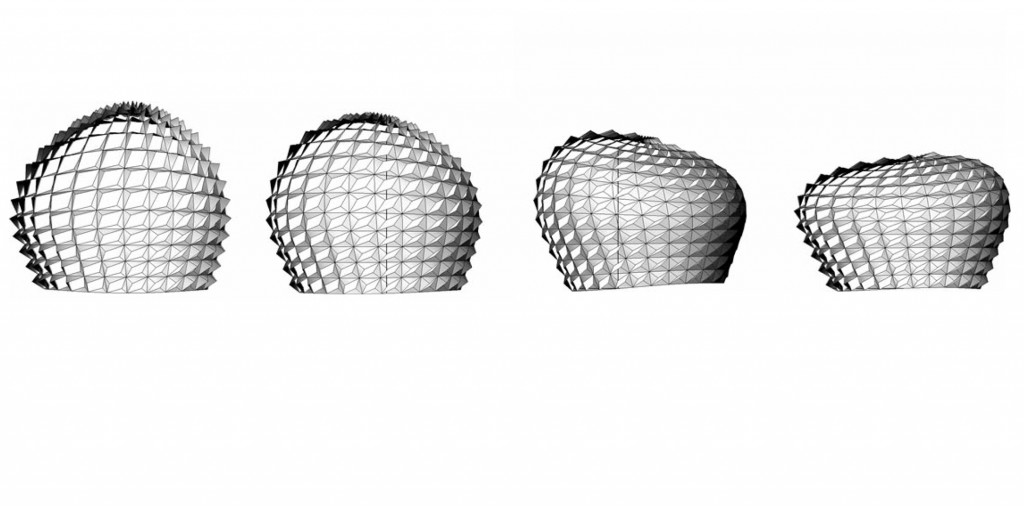
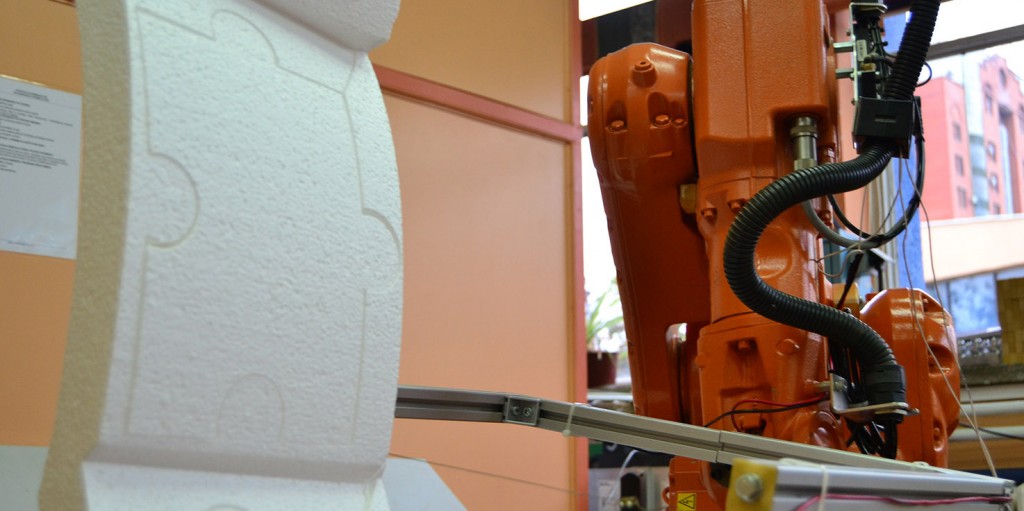
Abstract: In this paper a novel methodology is proposed for digital workflow and fabrication of a freeform shell made from foam materials utilizing a robot hot-wire cutting tool. The major issues of using freeform foam structures pertain to building complex shape constructions in contemporary architecture and fabrication of structural, insulated panels for double-curved walls. In order to provide an efficient method of freeform surface panelization, two different tessellation approaches are presented – a quadrilateral shaped panel and a puzzle shaped panel. A puzzle shaped panel is chosen for fabrication purposes, in order to test the benefits that come with it, including friction fit connections, and assemblability. Digital workflow based on the graphical algorithm editor Grasshopper is used for the development of complex panel shapes derived by tessellation procedures. The proposed method is tested through fabrication of a full scale architectural prototype.

Keywords: Robotic fabrication, Freeform structures, Puzzle shaped panels, Hot-wire cutting, Shape tessellation

Online version of article: Robotic fabrication of freeform foam structures with quadrilateral and puzzle shaped panels
Influence of changing trees locations on thermal comfort on street parking lot and footways

Dragan D. Milosevic, Ivana V. Bajsanski, Stevan M. Savic, 2017, Urban Forestry & Urban Greening, Vol. 23. pp.113-124

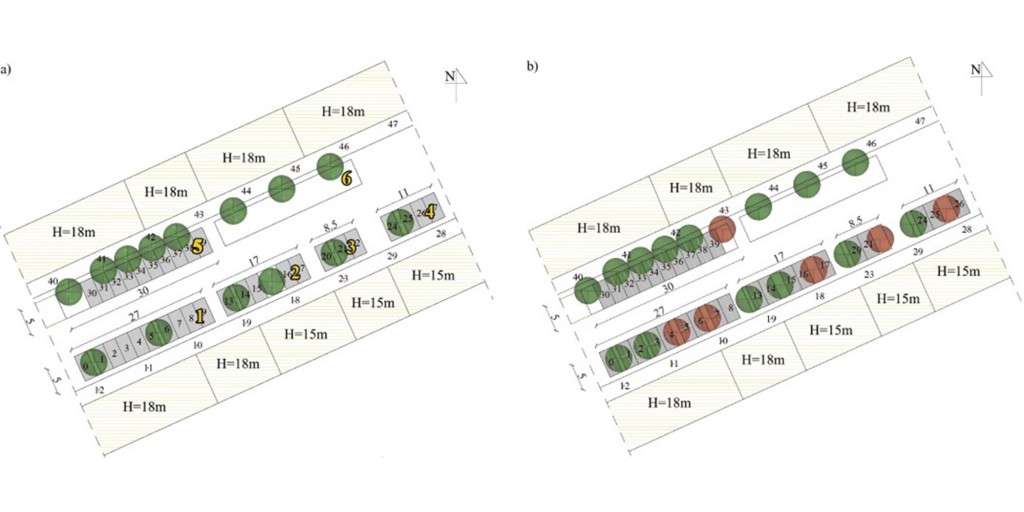
Abstract: Locations of trees in street parking lots (SPL) impact outdoor thermal comfort and should be considered during the urban planning process. In this paper we developed a procedure for changing trees locations in order to improve outdoor thermal comfort on SPL and associated footways. Furthermore, a sensitivity test on the effect of different tree crown shapes on outdoor thermal comfort was carried out. We applied theprocedure on real-world SPL design in the City of Novi Sad (Serbia). A temporal analysis is performed for the heat wave period using Universal Thermal Climate Index (UTCI) calculations in the Ladybug software. The results showed improvement of outdoor thermal comfort on 77 % of all body locations in proposed SPL design with predetermined number of trees. The largest outdoor thermal comfort improvement was noticed in the afternoon hours with up to 3.3 ◦C UTCI decrease on single body location. By adding trees to the SPL, heat stress was reduced on 84 % of all body locations with maximal UTCI decrease of 3.7 ◦C on single body location. Furthermore, heat stress reduction by cylinder-shaped tree crowns showed to be more pronounced compared to the sphere-shaped and the cone-shaped tree crowns. Proposed procedure showed that the locations of trees as well as tree crown shapes are very important for the improvement of outdoor thermal comfort and creation of environmentally conscious SPL design.

Keywords: Ladybug software, Outdoor thermal comfort, Street parking lot, Tree location, UTCI

Online version of article: Influence of changing trees locations on thermal comfort on street parking lot and footways

Distortion Minimization: A Framework for the Design of Plane Geometric Anamorphosis

V. Stojakovic, B. Tepavcevic, 2016, Nexus Network Journal,  pp 1-19  DOI 10.1007/s00004-016-0302-z.

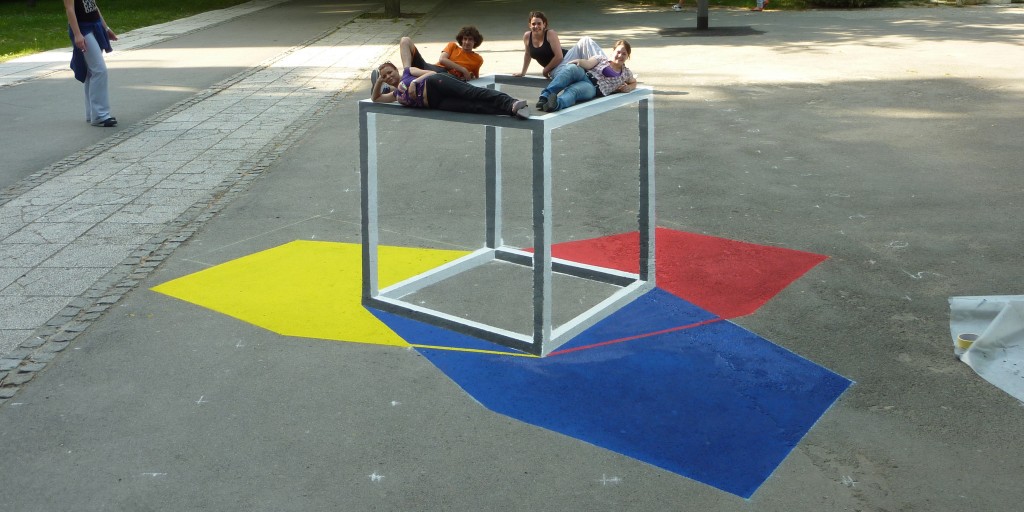
Abstract: Anamorphosis, as a drawing, represents shapes on a surface such that they appear in their natural form only under specific viewing conditions. Although anamorphoses are mainly studied in a historical context, they are currently experiencing a revival. Plane geometric anamorphoses are a specific sub-type of anamorphic drawings. Some practical problems may arise during the design and realization of plane geometric anamorphosis causing the 3D illusionistic effect to be impaired. The aim of this paper is to identify and analyze these problems. In the paper we use parametric analysis to quantify the distortion that may appear because the point of view is offset from the preferred point of view, and to simulate the deviations that can appear because of the errors in onsite realization. The analysis leads to a framework for the design of plane geometric anamorphosis that minimizes the impairment of the anamorphic illusion.

Keywords: Anamorphosis, Geometry, Perspective, Parametric analysis

Online version of article: Distortion Minimization: A Framework for the  Design of Plane Geometric Anamorphosis

Effect of tree location on mitigating parking lot insolation

I. Bajšanski, V. Stojaković, M. Jovanović, 2016. Computers, Environment and Urban Systems, Vol. 16. pp.59-67

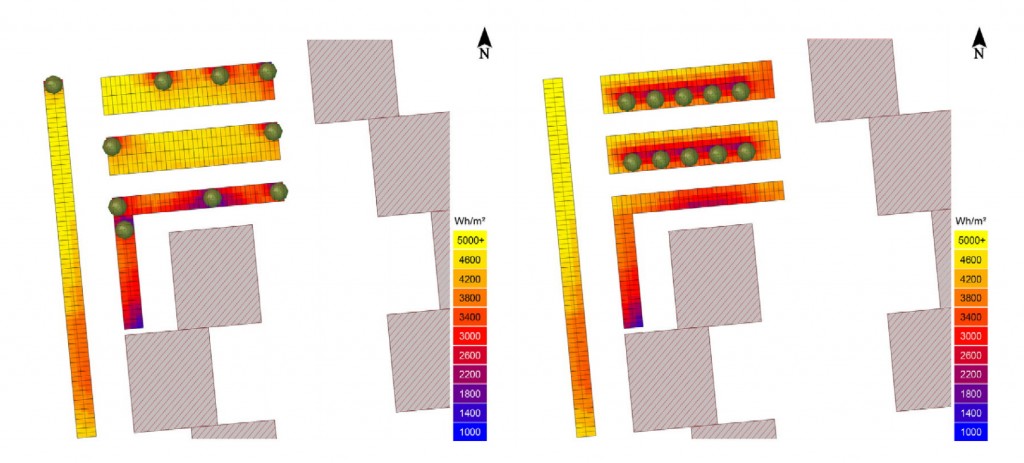
Abstract: Urban land used for parking lots can contribute to the effect of overheating, whereas vegetation, especially high growth vegetation (trees), can mitigate this effect. Accordingly, in this paper we propose an algorithm, the inputs to which consist of predetermined parameters of a parking lot’s geometry, trees and surrounding buildings, where the shadows help to mitigate the heat. The algorithm optimizes tree locations, aiming to provide maximum overshadowing of the parking lots, while leaving the useable parking area and the parking lot shape intact. The paper focuses on parameterization of elements that are important for this analysis process as well as combinatory calculations. These combinatory calculations are based on solar simulations, which are carried out, and take into account climate and geographical data. The algorithm is applied to several cases, depicting real world examples, as well as those based on design and greening instruction manuals. The results indicate that the tree locations estimated by the algorithm increase parking lot overshadowing, indicating that the algorithm efficiently decreases the negative influence of urban overheating.

Online version of article: Effect of tree location on mitigating parking lot insolation

Evaluation and improvement of outdoor thermal comfort in urban areas on extreme temperature days: Applications of automatic algorithms

I. Bajšanski, D. Milošević, S. Savić, Building and Environment, 2015, Vol 94. No 2. pp. 632–643.

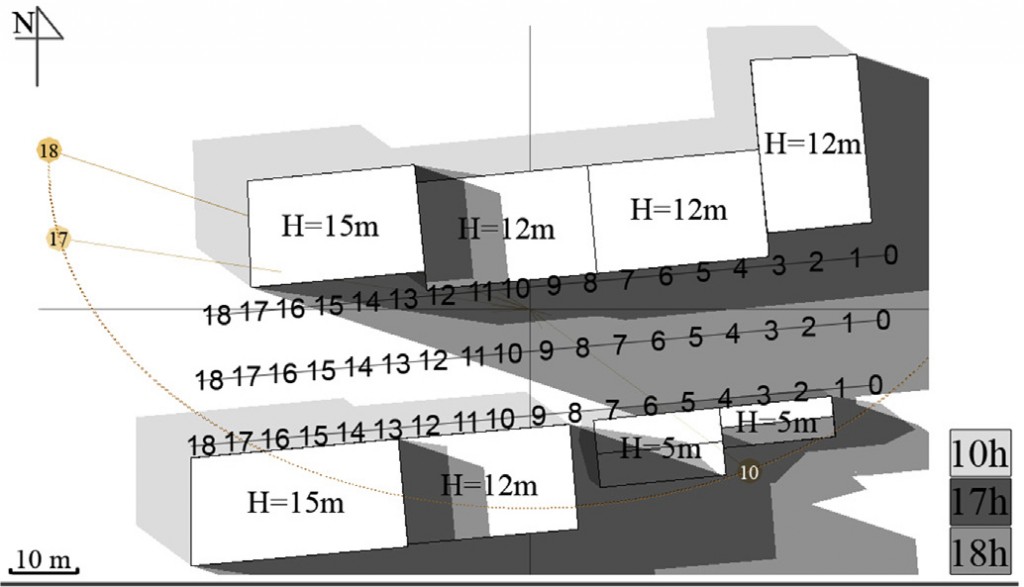
Abstract: The objective of this paper is to present and apply automatic algorithms to evaluate and improve nonstationary outdoor thermal comfort in urban areas. The effects of urban planning on thermal sensations are analyzed in three linear urban street designs and in non-linear arrangement of the streets with no vegetation in Novi Sad, Serbia. A temporal analysis is performed for extreme hot and cold days using universal thermal climate index (UTCI) simulations in the Grasshopper program. In future linear street design, the frequencies of the greatest thermal stress situations substantially decrease on hot summer days and slightly increase on cold winter days. Past, present, and future urban designs of linear street are compared, and the largest UTCI decreases are noted at 10, 17 and 18 UTC on hot summer days at 11 UTC on cold winter days. Future planed and proposed urban design of linear and non-linear streets is compared and the largest UTCI decreases are noted at 10 UTC on summer day and increases at 11 UTC in winter day. The building height and density increases in the future street design will modify the thermal environment. The proposed automatic algorithms are applicable for the analysis of human thermal comfort in various urban designs and climates.

Online version of article: Evaluation and improvement of outdoor thermal comfort in urban areas on extreme temperature days: Applications of automatic algorithms

Analysis of shape grammar application as a tool for urban design

M. Mandić, B. Tepavčević, 2015. Environment and Planning B: Planning and Design,   volume 42, pp. 675-687

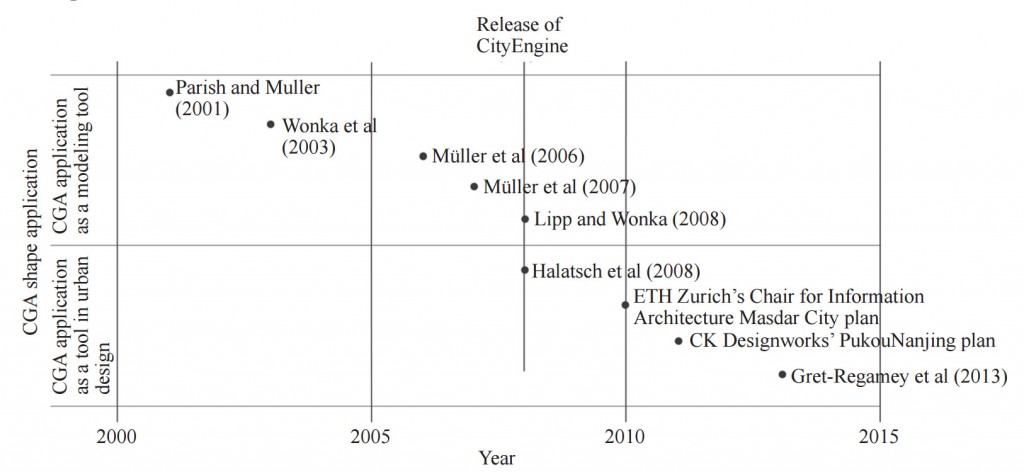
Abstract: In the past decade a certain number of studies have suggested that shape grammars and their capability for producing alternative solutions represent an adequate tool for overcoming complexities regarding urban design. In this paper we present a critical analysis of various approaches to shape grammar application in urban design. The aim of this research is to provide an insight into the current state-of-the-art developments and give a critical evaluation on the basis of the criteria of interactivity and flexibility in the approach. We identify two main concepts of grammar application in urban design and outline their characteristics. We conclude that a generic or context-independent approach to shape grammars can provide high levels of flexibility and interaction with the user. This, coupled with their ability to encode different layers of information, facilitates their use for design exploration and problem solving in an urban context.

Online version of article: Analysis of shape grammar application as a tool for urban design


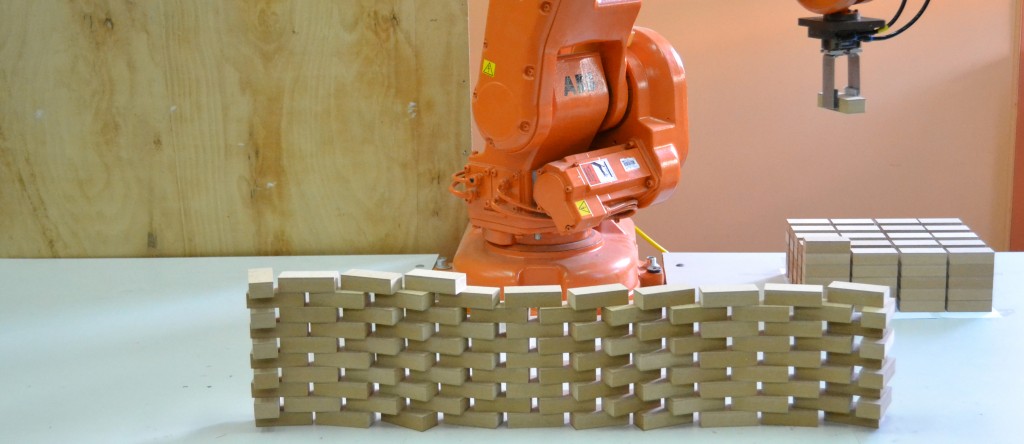
Design and Fabrication with Industrial Robot as Brick-laying tool and with Custom Script Utilization

Raković M., Jovanović M., Borovac B., Tepavčević B., Nikolić M., Papović M., IEEE International Conference on Robotics in Alpe-Adria-Danube Region, September 3-5, 2014. Smolenice, Slovakia


Abstract: This paper presents methodology and implementation of parametric architectural design of brick-laying walls fabricated by industrial robotic arm. As a design tool Grasshopper is used, a visual programming editor that runs within the Rhinoceros 3D CAD application. Grasshopper offers a range of objects for creating parametric models including brick-laying walls. However it lacks the ability of integration with fabrication tools. To overcome this problem, a custom C# script has been developed. As the fabrication tool, the ABB-IRB 140 robotic arm is used. Thus the C# script is written in such a way to obtain the RAPID code for controlling ABB industrial robots. The C# script enabled automated generation of RAPID code in accordance to the Grasshopper generated geometries of walls. The RAPID code is firstly tested in simulation environment, afterwards is used to control the robot to fabricate various types of walls.

Online version of article:

Design and Fabrication with Industrial Robot as Brick-laying tool and with Custom Script Utilization

Procedural Modeling in architecture based on statistical and fuzzy inference

B. Tepavčević, V. Stojaković,  Automation in Construction, 2013. Vol. 35. pp.329‐33.


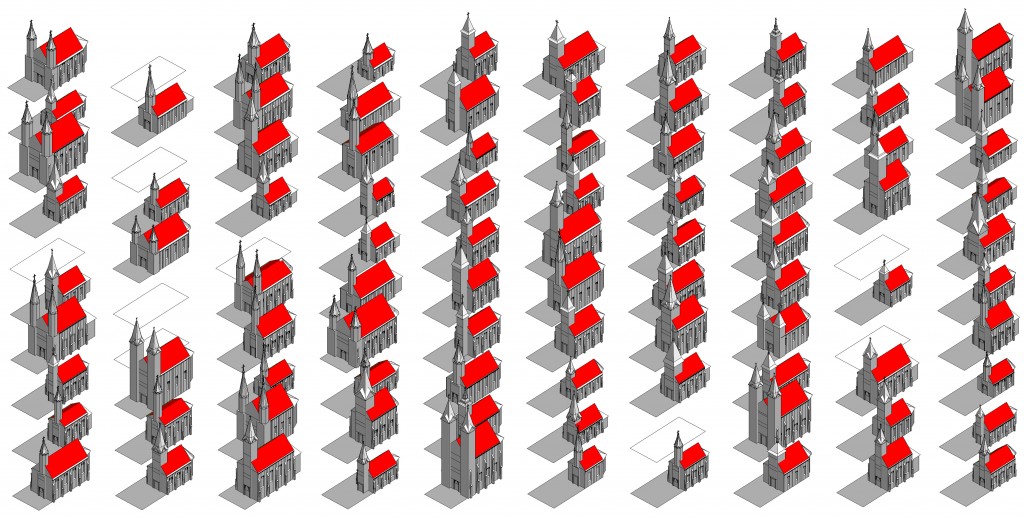
Abstract : In this research, we used a group of sacral buildings on the territory of Vojvodina. 3D mass models that are similar to the real world buildings are automatically generated via CGA Shape Grammar programming rules.The results demonstrate that coupling procedural modeling with fuzzy and statistical analysis enables generation of infinite number of buildings representing the typical appearance of an architectural type and their variations, which is a reliable reproduction of characteristics of the real world buildings. We also demonstrate the application of this approach in the simulation of architectural heritage appearance.

Online version of article:

Procedural Modeling in architecture based on statistical and fuzzy inference


Representation of Non-Metric Concepts of Space in Architectural Design Theories

B. Tepavčević, V. Stojaković, 2014. Nexus Network Journal, Vol. 16. No.2,  pp. 285-297.


Abstract :The concept of space is one of the most important parts of architectural theory. There are many theories of space in architecture which can be examined from different point of views including mathematics and philosophy. In a mathematical sense, most of the architectural space theories deal with the three-dimensional Euclidean geometry. However, the development of the contemporary architecture has been marked with some other geometric concepts as well. New concepts of space, different from the three-dimensional Euclidean space, have had an impact on architecture since the beginning of the twentieth century. Moreover, in the past two decades growing interest toward a non-metric conception of spaces, where a notion of distance is not relevant, emerged in the theory and design of some contemporary architects. In this paper the relationship between non-metric conception of spaces and architectural design theories are analyzed and evaluated in order to show and the extent to which they are related.


Online version of article:

Representation of Non-Metric Concepts of Space in Architectural Design Theories

Image-based surveying and modeling of the unprotected architectural heritage – a case study of st. Rudolf’s church

V. Stojaković, I. Bajšanski, 2013.  Proceedings of XXIV Cipa Symosium – 2013, INSA, Strasbourg, France, pp. 295-300

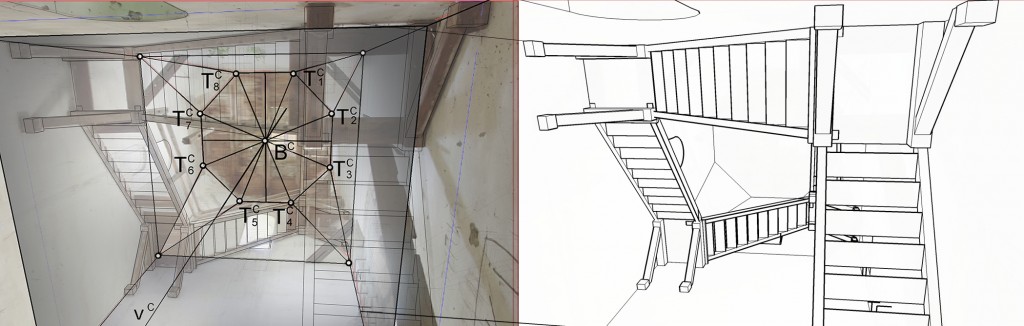
Abstract: The aim of this paper is to present image-based recording of the unprotected architectural heritage in threat and its advantages integrating different modeling methods. Considering the construction problems in unprotected buildings we applied variations of low-budget image-based 3D modeling reconstructions techniques and built the complete virtual 3D reconstruction of highly damaged church of St. Rudolph in Banostor. The resulting model reveals many construction and design details that can not be perceived by a simple observing.
In this paper, the importance of integrating a variety of measuring and modeling methodologies in order to achieve digital reconstruction of the unapproachable ruined building is demonstrated. The paper describes survey techniques and workflow, focusing on advantages as well as problems and limitations of each method.

Online version of article: Image-based surveying and modeling of the unprotected architectural heritage – a case study of st. Rudolf’s church